IFS Connect Nordics 2026
Last week I flew to Sweden to participate in IFS Connect Nordics. The event took place in Gothenburg in the World of Volvo, a nice city and a magnificent venue. The building, very modern with large windows, concrete and wood, was simultaneously used as a museum, showing the heritage of Volvo and as a conference venue.
The event was sold out; there were approximately 700 participants attending the event. The main event took place on Thursday with keynote speeches by IFS, by partners but also by customers. Most of the contents were focused on industrial AI and how this technology will and is changing business. There were various break-out sessions covering the different focused industries and the products in the IFS ecosystem. Apart from the speeches, approximately 15 partners were present with their booths.
Fridays’ event was under the leadership of the Scandinavian and the Finnish IFS user groups. The events concentrated on how IFS customers were using IFS to solve specific issues such as visual planning, lifecycle management or how a global roll-out was planned.
The first session on Friday morning was on Access Control – and as you can guess – I had to attend. The session was held by an IFS specialist who’s name I unfortunately did not catch. The session was advertised as “exploring how modern permission structures, user lifecycle management, and smarter governance can strengthen both security and productivity in IFS Cloud”. Approximately 100 people attended the 45-minute event.
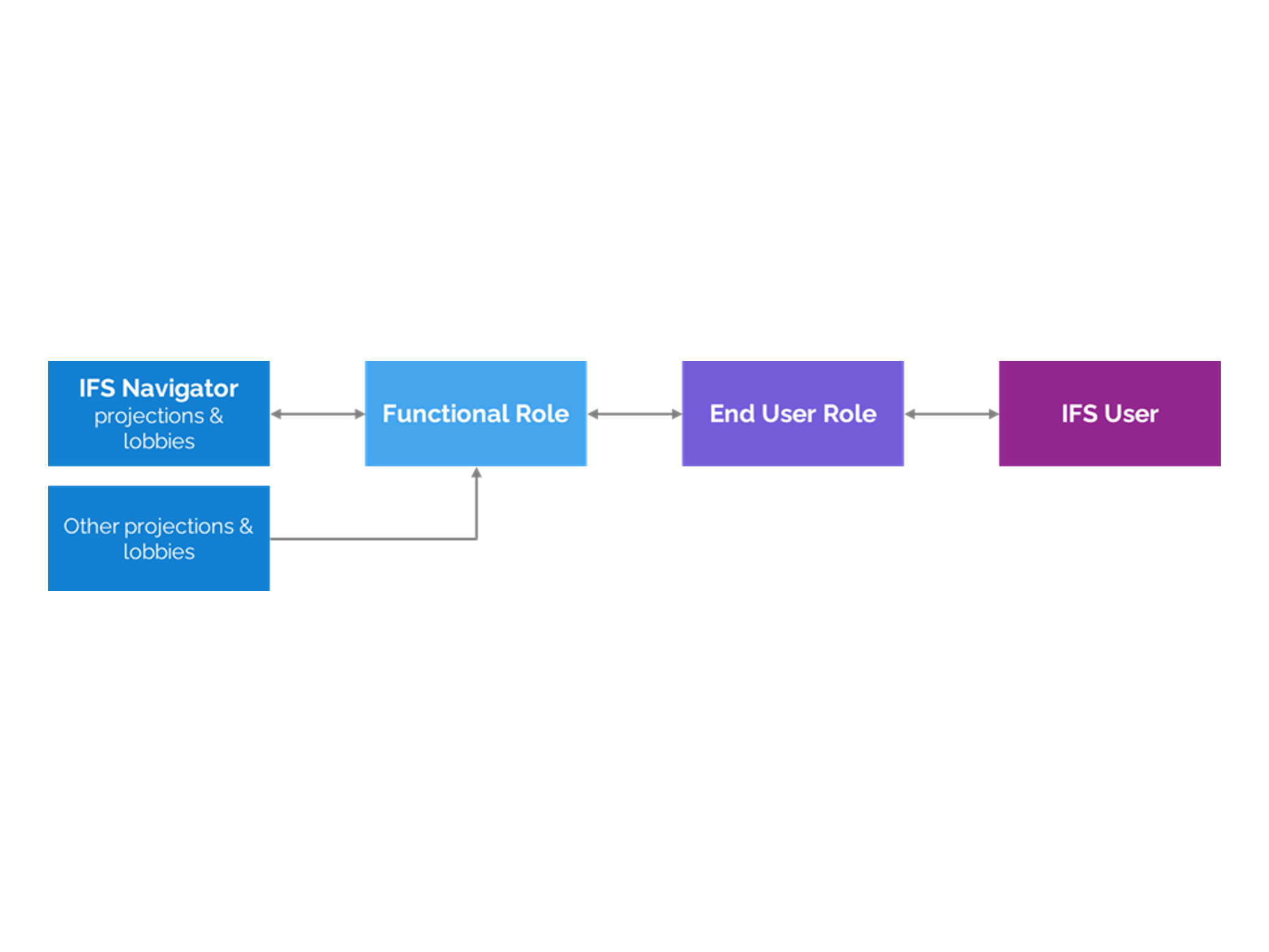
The speech covered how IFS thought customers should set up end-user roles, on what tools to use (Excel) and gave some examples of how end-user roles and functional permission sets were related.
I was very disappointed with the presented concepts and the presentation due to the following reasons:
- Excel-based: IFS suggested creating numerous tables in Excel with the Navigator structure, the functional permission sets, the end-user roles and the end-users. The first proposal was to start with Excel (to get an overview) and then copy and type all the settings into IFS. The second proposal concerning lifecycle management was to document all the settings and changes to the settings in the initially created Excel sheet. A question from the audience concerned what to do when the Navigator structure changes during the release changes. Here no proposal was made. In the IFS ecosystem there are numerous providers that offer tools to ease the set-up, management and documentation of the roles and permissions. I think the speaker should have given the audience this information.
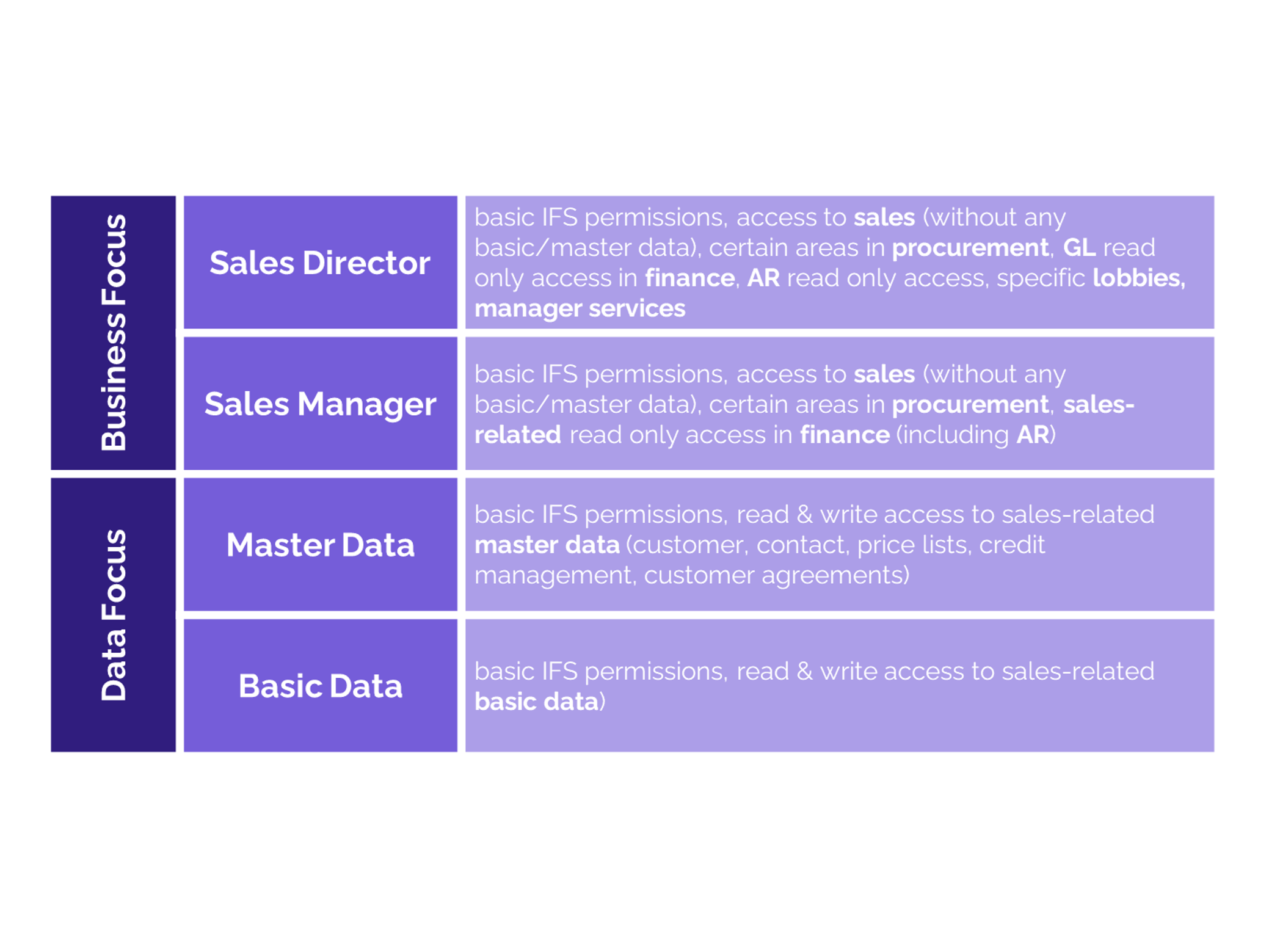
- Setting up End-user Roles (EUR) and Functional Roles (FR): The speaker suggested starting from scratch (“identify job roles, establish basic roles, conduct workshops, develop, test and document”). This approach is extremely time-consuming, error-prone and is basically re-inventing the wheel for each customer. Best practice IFS implementations nowaday usually start with a pre-tested set of EUR and FR. The IFS customers then carry out a fit/gap analysis and make corrections accordingly.
- No guidance and help: Each IFS implementation must define its Access Management, and a certain “best practice” has evolved over the years. Unfortunately, the speaker wasn’t able to present any of these best practices (e.g. separating basic data roles, “normal” number of EUR and FR, what doesn’t belong in an EUR, how to test).
- Missing information on Conversion: Many IFS customers are facing the fact that they must migrate from IFS Applications 10 to IFS Cloud. In Apps 10 these customers had a working set of roles and permissions. There was no help or guidance (e.g. decision criteria) on if and how to convert the existing setup. It is true that IFS doesn’t offer a migration path for Roles and Permissions, but there are providers in the market that do that for a fixed price.
My assessment of the talk (based on my high expectations) was like the comments I heard from various listeners and customers after the session. Most of the participants were disappointed with the presented solutions, IFS’s missing functional roadmap in this area, missing guidance/best practice, and the speech in general.
2BCS and Purple Services offer a bi-monthly webinar on IFS roles and permissions. The webinar, which has been running for over a year, presents and documents best practice in this area. After the speech, Magnus Ingemars (the coordinator of the Scandinavian IFS User Group) and myself agreed on sharing webinar best practice at an upcoming user group event. More to follow.
Contact Us